
News
NYCHA’s Chelsea Plan Collides with Its Residents

Residents of Chelsea’s Fulton and Elliott-Chelsea Houses (FEC) protested NYCHA’s planned demolition of their buildings with a march and rally on November 8th. The lack of tenant buy-in for the plan is increasingly an issue. The high-profile architecture firm PAU (Practice for Architecture and Urbanism) recently withdrew from the project to demolish and replace the buildings alongside new housing, citing concerns about resident support. In an October 30th lecture at the Spitzer School of Architecture, PAU Principal Ruchika Modi presented a slide of her firm’s mission statement: “PAU is an architecture and urban design studio dedicated to building ecological, equitable, and joyous communities.” Challenged by an audience member on the firm’s seemingly contradictory involvement in the NYCHA plan, Modi announced that PAU had bowed out of it because a large number of the residents were opposed to the project.
NYCHA’s Chelsea Gold Mine

A proposed rezoning of Chelsea’s public-housing sites—Fulton Houses and Elliott-Chelsea Houses—could transform much of the neighborhood to midtown-like density. It would introduce towers of up to 39 stories a stone’s throw from early-19th-century Greek Revival rowhouses. This New York City Housing Authority rendering shows new buildings it would construct under the rezoning in gold, viewed … NYCHA’s Chelsea Gold Mine
The Future Still Needs the Gimbels Skybridge

For nearly a century, the Gimbels skybridge has served as a kind of gatehouse announcing Pennsylvania Station on the next block west. Few would guess that its interior was once continuous with the station’s. The bridge will disappear if plans for the Empire Station Complex proceed. This would be a terrible loss. It is by far the most prominent aerial bridge from an era when the rest of the world looked to New York as the skyscraping, multi-level City of the Future—the crowning example of a phenomenon that influenced modern architecture and still captivates and inspires.
New plans still say “teardown” for Chelsea’s oldest house
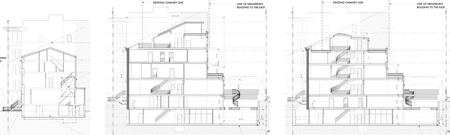
In an April 19 public hearing, the Landmarks Preservation Commission asked 404 West 20th Street’s new owner Ajoy Kapoor to return with a more appropriate proposal for altering it. Just released, the revised proposal will go before a public meeting of the Commission on Tuesday. The new design takes a little off the top and still … New plans still say “teardown” for Chelsea’s oldest house
Saving the Seamen’s House YMCA
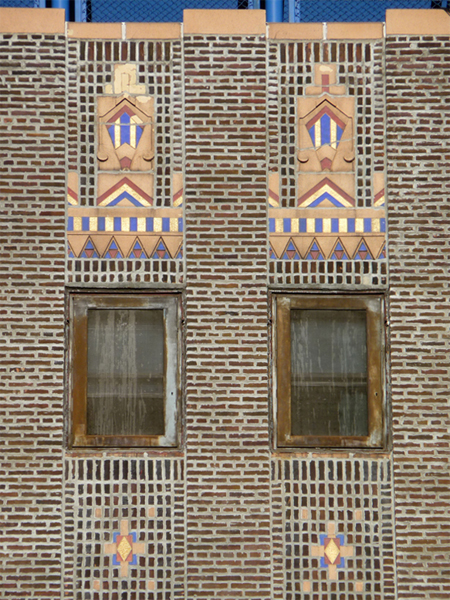
Designed as a waterfront YMCA for sailors, Seamen’s House has scores of multi-colored terra cotta highlights. Stylized ships’ prows, waves, and Jazz Age riffs on the YMCA’s triangle logo are deployed for maximum effect, lighting up the building’s roof line and window heads. They are an integral part of the building’s composition, and their cleaning and minimal restoration would do much … Saving the Seamen’s House YMCA
Looking Over the Bike Share Gift Horse

Central Park users rub shoulders with cars on the main loop road until 7PM on weekdays, even though Olmsted and Vaux’s 1857 park design is predicated on sunken transverse roads to block out the sight and sound of street traffic. It’s hard to say what’s worse; the exhaust sucked into lungs of joggers or the nullification … Looking Over the Bike Share Gift Horse
Mythical Lower Manhattan, Part 1 – In Memory of Lebbeus Woods
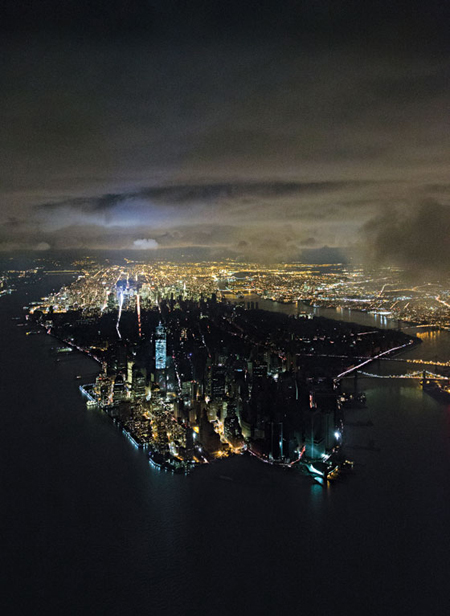
The Dutch architectural photographer Iwan Baan took this helicopter photo of Downtown blacked-out by Hurricane Sandy. A memorable New York Magazine cover, it resonates with a century-old genre; views of a transformed Lower Manhattan from above New York Harbor. Lebbeus Woods died on October 30th, as Sandy left his downtown neighborhood in the darkness … Mythical Lower Manhattan, Part 1 – In Memory of Lebbeus Woods
The Chelsea Market Deal, brought to you by ULURP

From right to left, Amanda Burden, Christine Quinn, Mayor Bloomberg and Boss Tweed reprise Thomas Nast’s ring of passed blame around Chelsea Market in a flyer that’s started appearing on Chelsea streets. On October 19th, I and others met with City Council Speaker Christine Quinn to discuss Jamestown Properties’ proposed rezoning of Chelsea Market, aimed at adding … The Chelsea Market Deal, brought to you by ULURP
Buying Michael Bolla’s Chelsea Mansion for Dummies
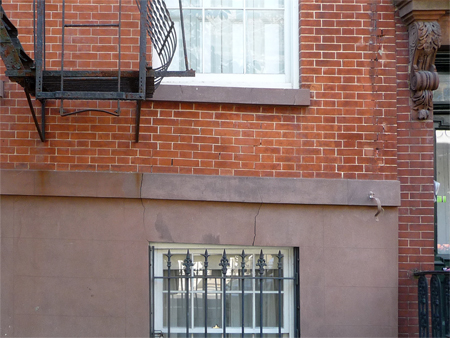
A Daily News article on Michael Bolla’s restoration of 436 West 20th Street said “the house was raised 8 inches to become more level.” It appears to be tied to the house next door by a shared party wall. If Bolla raised his house without considering this, it might explain his house’s cracked and sloping façade. … Buying Michael Bolla’s Chelsea Mansion for Dummies
Is the City Building Google a High Line Skybox?
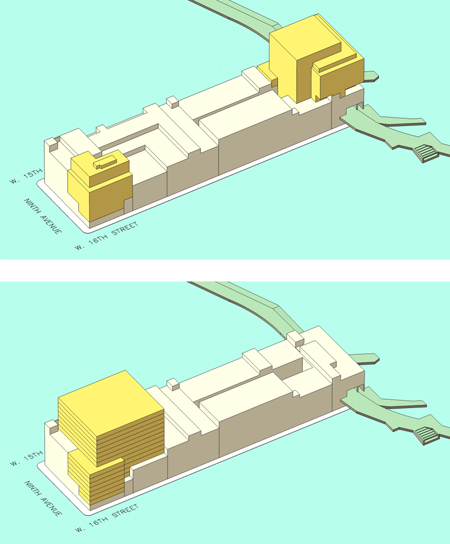
Shown in gold at top are Jamestown Properties’ proposed additions to Chelsea Market: 90,000 square feet at Ninth Avenue and 240,000 square feet at Tenth Avenue above the High Line, which is shown in green. Below is what Jamestown’s proposal might look like, give or take a floor, if it were really about needed office … Is the City Building Google a High Line Skybox?
High Noon at Chelsea Market
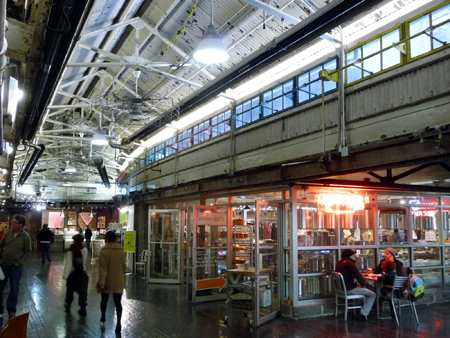
The west end of Chelsea Market’s concourse incorporates the historic Nabisco complex’s train shed. About eighty feet of its distinctive clerestory window strip would be blocked by courtyard infill from Jamestown Properties’ proposed addition of a third of a million square feet of office space above it and the High Line. Jamestown’s proposal requires a … High Noon at Chelsea Market
Jamestown’s Shady Plan for Chelsea Market
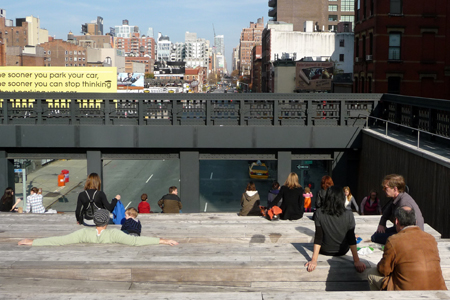
Last Sunday’s sunshine made the High Line’s “Tenth Avenue Square” a pleasant place to relax, even in late November. The popular grandstand feature would be cast into shadow at the hour this photo was taken if Jamestown Properties builds its planned office tower over Chelsea Market. The effect would be particularly damaging to a park … Jamestown’s Shady Plan for Chelsea Market
Last Call for Jaume Plensa’s “Echo”
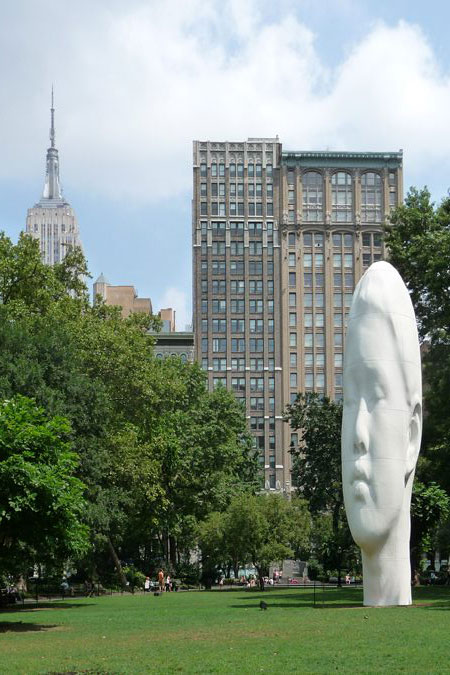
Echo, a belief-defying work by Spanish sculptor Jaume Plensa (JOW’-meh PLEHN’-sah) remains on view for only two more weeks, through September 11th. Like Plensa’s own Crown Fountain and Anish Kapoor’s Cloud Gate (aka The Bean), both in Chicago’s Millennium Park, Echo is both art and crowd-pleasing phenomenon. Sadly, unlike those works, Echo is not a permanent … Last Call for Jaume Plensa’s “Echo”
Midtown Undone
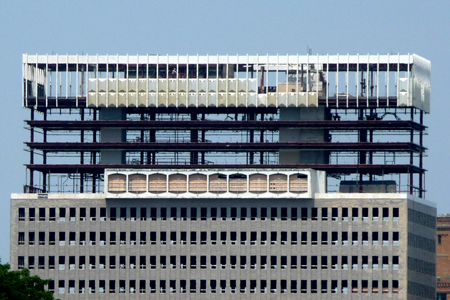
Photographed last week, Midtown Plaza’s piecemeal demolition brings the look of a ship breaking yard to the skyline of Rochester, New York. The image may be bracing to those who remember the project’s promise of urban renewal when it was completed in 1962, to the design of urban planner Victor Gruen. According to the Wikipedia … Midtown Undone
Losing Ground at Chelsea Square

Architect Charles C. Haight modeled the General Theological Seminary’s bell tower on Magdalen College’s, Oxford. This view of it from Tenth Avenue and 20th Street would be blocked by Beyer Blinder Belle’s proposed addition to the Seminary’s 1836 West Building. The Seminary’s mid-block grounds were designed to complement set-back garden fronts and distinguished row … Losing Ground at Chelsea Square
What New Zoning Could Mean for Chelsea Market

The Landmarks Preservation Commission has denied a recent community request to add the Chelsea Market block to the existing Gansevoort Market Historic District. In a May 19th response to the Request for Evaluation, the Commission’s Director of Research wrote that “the properties do not appear to meet the criteria for designation . . . in part … What New Zoning Could Mean for Chelsea Market