

The Iron Triangle, part 1 / Wilson’s Garage
Once a swamp and then an ash dump, the ground of the Iron Triangle in Willets Point, Queens, now feels like both. Its businesses have an unacknowledged ancestor within one of the greatest works of American literature. The Great Gatsby was going to be called Among Ash Heaps and Millionaires until the great Scribners editor Max Perkins persuaded F. Scott...Continue reading→

Architecture Meets Science Fiction at 41 Cooper Square
Thom Mayne’s new academic building for Cooper Union, 41 Cooper Square, is the Pritzker Prize winning architect’s first building in New York. Sensual, jarring and willfully strange, it’s unlike anything else in the city. New Yorkers won’t find a meaningful introduction to Mayne or his building anywhere in the popular press. Fifteen years ago, a...Continue reading→

5 Folding Bikes for the City
Brompton World Championship racers in obligatory jacket and tie depart from Blenheim Palace. The dress code suggests both the folding bike’s roots in English quirkiness and its usefulness for urban commuting. There’s no better way to take possession of a city than on a compact folding bike. Neighborhoods that would be discouragingly distant on foot...Continue reading→

The Farnsworth House, part 3 / the progeny
When it was completed in 1951, the Farnsworth House was a window into the future. Still inspiring new interpretations, it has the open-endedness of great art. The economy with which the Farnsworth House elicits its richness of response is one proof of “less is more.” With minimalism and technology the tines of its tuning fork, the house’s reverberations are as...Continue reading→
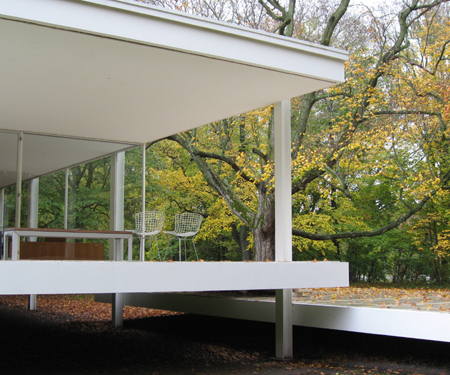
The Farnsworth House, part 2 / from the hearth to the field
Mies van der Rohe prepared renderings of two early versions of the Farnsworth House, one on the ground and the other raised above it. The choice to elevate its floor five feet responded to potential flooding of the nearby Fox River, but also exalted the house, made it appear to float, and gave it...Continue reading→

The Farnsworth House, part 1 / whose less is more?
Mies van der Rohe’s Farnsworth House design was publicly presented in a 1947 Museum of Modern Art retrospective of his work curated by Philip Johnson. Mies had first conceived of a glass house in 1945. Johnson later said, “I pointed out to him that it was impossible because you had to have rooms, and that meant...Continue reading→