

House Rule 5 – Engage the Outdoors
An illustration from William A. Bruette’s 1934 book, Log Camps & Cabins, shows an example of a cabin open at one end like a cave. Outside, a campfire extends the domestic realm into nature. The composition is the barest refinement of primitive man’s cave with banked fire outside. The book’s epigraph reads: “The cabin...Continue reading→
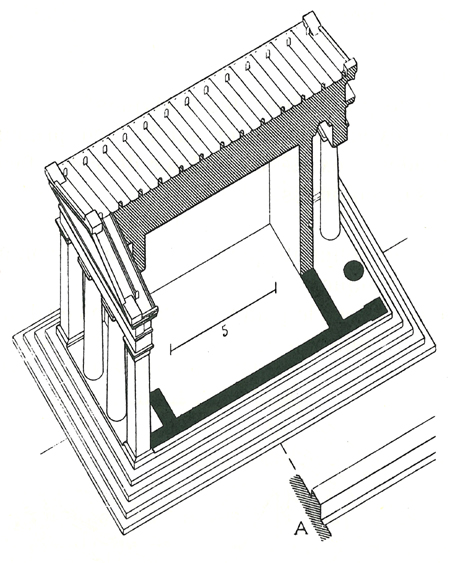
House Rule 4 – Pursue a One-Room Ideal
A cutaway drawing of the Temple of Diana Propylaea at Eleusis illustrates Auguste Choisy’s 1899 Histoire de L’Architecture. From tepees to temples to iconic mid-century glass houses, one-room buildings derive a primitive power from their simple integration of interior and exterior.

House Rule 3 – Design from a Diagram
“A Lake or River Villa for a Picturesque Site” illustrates A.J. Downing’s 1850 book, The Architecture of Country Houses. Its orderly cruciform plan of perfectly shaped rooms is undisturbed by the messy supporting business of kitchen, laundry and storage hidden out back. Unprepared for the encroachment of modern equipment, the villa’s designer simply tacks on a perfunctory service wing that...Continue reading→

House Rule 2 – Combine Living Spaces
Frank Lloyd Wright’s Hickox House of 1900 opens its dining room, living room and library onto each other, combining them into a single expansive living space that runs the full length of the house. The glazed ends of this space imply its infinite exterior projection, even as the doors leading from its center onto a terrace...Continue reading→

House Rule 1 – Build a Small and Simple Shell
Cape Cod, saltbox, colonial, barn; American vernacular prototypes have simple rectangular plans, and shapes that are mere extrusions of their end walls. These plain and practical forms represent the oldest and arguably most authentic stream of American domestic architecture.

436 West 20th Street Rises Above the Law
White stains of efflorescence mark new brickwork at 436 West 20th Street. The gable end of the 1835 rowhouse has been raised several feet and given a gambrel profile. The original peaked roofline is clearly legible in darker-looking brick, about four feet down from the new roofline. “You have to pay attention to history,” the building’s new owner and co-developer, Michael Bolla...Continue reading→