admin

House Rule 3 – Design from a Diagram

“A Lake or River Villa for a Picturesque Site” illustrates A.J. Downing’s 1850 book, The Architecture of Country Houses. Its orderly cruciform plan of perfectly shaped rooms is undisturbed by the messy supporting business of kitchen, laundry and storage hidden out back.  Unprepared for the encroachment of modern equipment, the villa’s designer simply tacks on a perfunctory service wing that House Rule 3 – Design from a Diagram

Read More

House Rule 1 – Build a Small and Simple Shell

Cape Cod, saltbox, colonial, barn; American vernacular prototypes have simple rectangular plans, and shapes that are mere extrusions of their end walls.  These plain and practical forms represent the oldest and arguably most authentic stream of American domestic architecture.

Read More

436 West 20th Street Rises Above the Law

White stains of efflorescence mark new brickwork at 436 West 20th Street.  The gable end of the 1835 rowhouse has been raised several feet and given a gambrel profile.  The original peaked roofline is clearly legible in darker-looking brick, about four feet down from the new roofline.  “You have to pay attention to history,” the building’s new owner and co-developer, Michael Bolla 436 West 20th Street Rises Above the Law

Read More

House Rules – Introduction

  A 1958 Corvette, one of the last models designed by the line’s visionary creator, Harley Earl.   No design product is more quintessentially American than a first generation Corvette.  Much of its appeal lies in just how little it puts between its occupants and the road and open air.  It is as much about the House Rules – Introduction

Read More

Windowflage, part 4

Linked Hybrid, a Beijing complex designed by Steven Holl, was completed last year.  As with his Simmons Hall dormitory at MIT, Holl sets windows deeply into a uniform and pervasive grid, camouflaging them as dimples in an enveloping waffle texture that’s applied like shrink-wrap.  He so accentuates the window grid that it takes on the geometric purity of abstract sculpture.  Like many Windowflage, part 4

Read More

Windowflage, part 3

“The Loneliest Job”, an unposed 1961 photo of JFK in the Oval Office by George Tames (The New York Times) shows how a window can express individual presence and uniqueness of outlook.  At a traditional domestic scale, even an empty window invokes human presence as surely as a Van Gogh painting of an empty chair or pair of shoes.  If Windowflage, part 3

Read More

Windowflage, part 2

The architect Edward Durrell Stone built this Manhattan townhouse for himself at 13 East 64th Street in 1956.  Stone’s American Embassy in New Delhi was under construction at the time of its design.  He had given the embassy a similar screen to protect it from the sun, and here recycled the idea for privacy.  Stone would go on using screens to Windowflage, part 2

Read More

Windowflage, part 1

  The Coney Island Elephantine Colossus is an object lesson in the need for windowflage, the camouflaging of windows in the service of a building’s overall sculptural effect.  The work of Philadelphia architect William Free, it was built in 1883-85 as a hotel and later became a brothel.  In 1896, it departed this world in true Coney Island style by burning down.  Windowflage, part 1

Read More

The Iron Triangle, part 2 / from Kowloon Walled City to Singapore

No place in New York elicits such wonder at the retina’s capacity as the Iron Triangle.  Self-contained, densely packed and eye-boggling, it is an alternate reality recalling Hong Kong’s Kowloon Walled City, demolished in 1993-4, below. Comparing the vibrancy of the Iron Triangle to the city’s canned and bland development plan for it brings to mind William Gibson’s 1993 Wired The Iron Triangle, part 2 / from Kowloon Walled City to Singapore

Read More

Architecture Meets Science Fiction at 41 Cooper Square

Thom Mayne’s new academic building for Cooper Union, 41 Cooper Square, is the Pritzker Prize winning architect’s first building in New York. Sensual, jarring and willfully strange, it’s unlike anything else in the city. New Yorkers won’t find a meaningful introduction to Mayne or his building anywhere in the popular press. Fifteen years ago, a Architecture Meets Science Fiction at 41 Cooper Square

Read More

5 Folding Bikes for the City

Brompton World Championship racers in obligatory jacket and tie depart from Blenheim Palace.  The dress code suggests both the folding bike’s roots in English quirkiness and its usefulness for urban commuting. There’s no better way to take possession of a city than on a compact folding bike.  Neighborhoods that would be discouragingly distant on foot 5 Folding Bikes for the City

Read More

The Farnsworth House, part 3 / the progeny

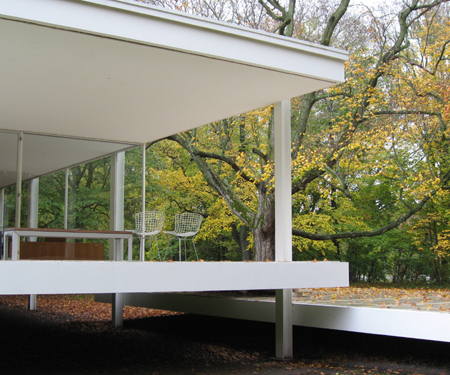
    When it was completed in 1951, the Farnsworth House was a window into the future.  Still inspiring new interpretations, it has the open-endedness of great art.  The economy with which the Farnsworth House elicits its richness of response is one proof of “less is more.”  With minimalism and technology the tines of its tuning fork, the house’s reverberations are as The Farnsworth House, part 3 / the progeny

Read More