The Seamy Side of 436 West 20th Street

October 7th, 2010 by admin


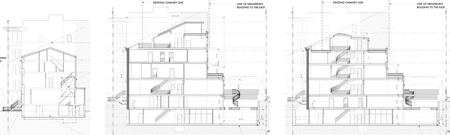
436 West 20th Street has recently added a prominent steel I-beam above its roof ridge and a large skylight on its north slope as shown in this photo taken on September 15th.  A visit that day to the Landmarks Preservation Commission and the Department of Buildings found no evidence of applications or approvals for these additions to the 1835 rowhouse, which falls within the Chelsea Historic District.  The Landmarks Commission’s Rowhouse Manual specifically states that a permit is required for construction of a skylight within a historic district (although it doesn’t address big red I-beams).  One end of the new beam is supported by the building’s west gable wall, at right in the photo above.  The top of this wall was historically lower and almost flush with the roof plane.  It now extends above the roof, creating a parapet.  The wall’s profile has further been changed by the introduction of a level section at the bottom of its front slope.  The house’s brick chimneys were rebuilt to their current, and likely original, height as approved by the Landmarks Commission, but then extended by several feet with prominent sheet-metal turbine ventilators.  Even the rearmost of these is visible from the street.  ArchiTakes first posted photographic evidence of unapproved construction at 436 West 20th Street in March.  Within weeks, the Landmarks Commission issued violations and the Department of Buildings audited and failed the building’s job filing.  The building’s owner and developer, realtor-to-the-stars Michael Bolla, responded with threats of legal action aimed at silencing ArchiTakes. Read the rest of this entry »

House Rule 9 – Build for Flexibility

September 23rd, 2010 by admin


While not the first great modern house, Mies van der Rohe’s Farnsworth House is without doubt the most influential today.  It embodies two especially pertinent ideas that support flexibility.  Its standardized industrial components suggest a demountable and reusable kit-of-parts architecture which, sixty years since, is the concept behind today’s explosive proliferation of prefabricated modular and recyclable housing solutions.  The Farnsworth House is spatially adaptable as well.  Its open plan reflects Mies’s ideal of timeless “universal space,” the usefulness of which might outlive ephemeral functional assignments.  From the wheelchair of his later years, Mies would have appreciated a further merit of this open plan; its lack of physical barriers.  Such a house has the potential to remain useful to an occupant whose own physical condition changes.  Mies raised the Farnsworth House several feet off the ground to protect it from the flooding of an adjacent river, abandoning an on-grade alternative scheme might have made it truly accessible. Read the rest of this entry »

Chelsea Mansion: The Art of Fiction

August 12th, 2010 by admin


In February, a Daily News article by Jason Sheftell described 436 West 20th Street as “one of the most perfectly restored homes in Manhattan.”  Cracked and displaced bricks and window lintels are now features of its façade, following restoration by its owner, the real estate broker Michael Bolla.  ArchiTakes first reported on the building in a March post, “436 West 20th Street Rises Above the Law.” Bolla is now marketing the 1835 rowhouse as “Chelsea Mansion.”   It stands within the Chelsea Historic District. Read the rest of this entry »

House Rule 8 – Use Trees

August 5th, 2010 by admin


“Light takes the Tree; but who can tell us how?”  Theodore Roethke asked in his 1953 poem, “The Waking.”  Trees have been our natural environment since before we came down from them, and they hold a deeply embedded place in the human psyche.  Their generations of leaves are an intuitive metaphor for death and renewal.  In a poem that contemplates mortality, did Roethke want his listeners to unconsciously hear “blight takes the tree?”  Or just recall the redemptive wonder we feel on seeing a tree mysteriously transformed by sunlight?  Beyond a metaphysical import, every tree has specific qualities that might influence its selection as an intermediary between artificial shelter and nature.  The poplar pictured above, for example, has brittle leaves that make the wind audible as a gentle clapping.   Read the rest of this entry »

House Rule 7 – Optimize Natural Light

July 22nd, 2010 by admin


Johannes Vermeer’s The Music Lesson was painted in the early 1660s.  As in most of Vermeer’s thirty-odd paintings, light enters from the left, spreading itself across a rear wall.  The situation is modeled on his studio, where a window and wall intersected to create just such a wash of illumination.  While light can be visibly suspended in the thick air of haze or smoke, it typically manifests itself on the surfaces it strikes.  Vermeer portrayed this presence so strongly that light is said to be a character in his paintings.   Read the rest of this entry »

House Rule 6 – Integrate Furniture

June 10th, 2010 by admin


Architect Jørn Utzon’s home, Can Lis, was completed in 1972.  Composed of individual structures and courtyards, it stands on a cliff overlooking the sea in Majorca, Spain.  A one-room building at its center contains a built-in crescent seat facing the vista through deep openings, with a fireplace on one side. Read the rest of this entry »

House Rule 5 – Engage the Outdoors

May 27th, 2010 by admin


An illustration from William A. Bruette’s 1934 book, Log Camps & Cabins, shows an example of a cabin open at one end like a cave.  Outside, a campfire extends the domestic realm into nature.  The composition is the barest refinement of primitive man’s cave with banked fire outside.  The book’s epigraph reads:  “The cabin in the forest, on the banks of a quiet lake or buried in the wilderness back of beyond, is an expression of man’s desire to escape the exactions of civilization and secure rest and seclusion by a return to the primitive.”  Or in Huck Finn’s words, “The Widow Douglas she took me for her son, and allowed she would sivilize me; but it was rough living in the house all the time, considering how dismal regular and decent the widow was in all her ways; and so when I couldn’t stand it no longer I lit out. I got into my old rags and my sugar-hogshead again, and was free and satisfied.”  Few humans would prefer any kind of architecture to the pleasure and freedom of being outdoors in comfortable weather.  Even without retreating “back of beyond,” houses can make the most of their devil’s bargain between shelter and space. Read the rest of this entry »

House Rule 4 – Pursue a One-Room Ideal

May 13th, 2010 by admin


A cutaway drawing of the Temple of Diana Propylaea at Eleusis illustrates Auguste Choisy’s 1899 Histoire de L’Architecture.  From tepees to temples to iconic mid-century glass houses, one-room buildings derive a primitive power from their simple integration of interior and exterior. Read the rest of this entry »

House Rule 3 – Design from a Diagram

April 29th, 2010 by admin


“A Lake or River Villa for a Picturesque Site” illustrates A.J. Downing’s 1850 book, The Architecture of Country HousesIts orderly cruciform plan of perfectly shaped rooms is undisturbed by the messy supporting business of kitchen, laundry and storage hidden out back.  Unprepared for the encroachment of modern equipment, the villa’s designer simply tacks on a perfunctory service wing that drifts off the page while he focuses on the familiar building blocks of room and stair.  Today’s house designer has even more services to integrate, with bathrooms, wrap-around kitchens, utility rooms and attached garages.  He seems just as ill prepared to integrate these, and often puts up a dummy house-front of formal rooms to simplify composition of the street façade and to serve as an uninhabited buffer zone shielding the private family spaces and their services in back.  As with Downing’s example, the rear face of today’s house is a secondary concern.  The accidental backs to be glimpsed across rear yards of housing tracts attest to this.  Modern house-plan fare visibly strains to juggle curb appeal, integrity of rooms, and integrated services.  Downing’s example drops the ball on incorporation of services in favor of whole rooms and a picturesque face.   Read the rest of this entry »

House Rule 2 – Combine Living Spaces

April 15th, 2010 by admin


Frank Lloyd Wright’s Hickox House of 1900 opens its dining room, living room and library onto each other, combining them into a single expansive living space that runs the full length of the house.  The glazed ends of this space imply its infinite exterior projection, even as the doors leading from its center onto a terrace allow the living room to spill outside.  “Vista without and vista within,” were Wright’s words for the effect.  The outward thrust of the living space is countered by its focal hearth.  Wright attuned his houses to the ingrained daily rhythm by which our forebears faced outward to hunt and gather in the landscape by day and returned to the fire at night, tapping into the primitive brain with the calculation of a movie about alien predators.  In its human insight, its simultaneous appropriation of exterior space and indoor simulation of outdoor scale, and its diagrammatic clarity – pure living pavilion on one side and unintruding support functions on the other – the Hickox House is a particularly compact illustration of Wright’s multilevel genius.  It was a radical dwelling in its time.  In his 1954 book, The Natural House, Wright described how he had broken the box of the American house a half-century earlier: 

“Dwellings of that period were cut up, advisedly and completely, with the grim determination that should go with any cutting process.  The interiors consisted of boxes beside boxes or inside boxes, called rooms.  All boxes were inside a complicated outside boxing.  Each domestic function was properly box to box.  I could see little sense in this inhibition, in this cellular sequestration that implied ancestors familiar with penal institutions, except for the privacy of bedrooms on the upper floor.  They were perhaps all right as sleeping boxes.  So I declared the whole lower floor as one room, cutting off the kitchen as a laboratory . . .  Then I screened various portions of the big room for certain domestic purposes like dining and reading.  There were no plans in existence like these at the time. . . .  The house became more free as space and more livable too.  Interior spaciousness began to dawn.”

The lived-in rear of today’s typical American house, with its combined kitchen, informal dining area and family room, owes its existence to Wright’s pioneering vision, even as today’s self-contained, under-used and obligatory formal living and dining rooms are over a century behind him.  


Rule 2 is to combine living spaces. 


 Who has more?

Combine living, dining and other activity areas to partake of each other’s space.  Create a single generous area rather than several smaller constrained rooms.  If private activity areas are needed, incorporate them in bedrooms or circulation space, so these do double-duty.  Most homeowners spend the great majority of their at-home waking time not only in a favorite room, but on one or two favorite pieces of furniture, and even the richest mansion owner can experience only one room at a time.  Redirect resources from unnecessary partitions and redundant spaces into the best of all possible – and always used – living spaces.       

House Rule 1 – Build a Small and Simple Shell

April 1st, 2010 by admin

Cape Cod, saltbox, colonial, barn; American vernacular prototypes have simple rectangular plans, and shapes that are mere extrusions of their end walls.  These plain and practical forms represent the oldest and arguably most authentic stream of American domestic architecture. Read the rest of this entry »

436 West 20th Street Rises Above the Law

March 18th, 2010 by admin

White stains of efflorescence mark new brickwork at 436 West 20th Street.  The gable end of the 1835 rowhouse has been raised several feet and given a gambrel profile.  The original peaked roofline is clearly legible in darker-looking brick, about four feet down from the new roofline.  “You have to pay attention to history,” the building’s new owner and co-developer, Michael Bolla was quoted in the Daily News last month.  “It tells you everything.  Here history told us to spare no expense to return the house to its original form.  This house has all kinds of history.”  The house in fact falls within the Chelsea Historic District, and its exterior is therefore the equivalent of a designated landmark.  In raising its roofline, Bolla has violated the permit his renovation was issued by the Landmarks Preservation Commission.  With the raised gable end, Bolla appears to be setting the stage for a raised roof, and maximum exploitation of a penthouse he clearly views as a cash cow. Read the rest of this entry »

House Rules – Introduction

March 11th, 2010 by admin


A 1958 Corvette, one of the last models designed by the line’s visionary creator, Harley Earl.


No design product is more quintessentially American than a first generation Corvette.  Much of its appeal lies in just how little it puts between its occupants and the road and open air.  It is as much about the experience it promises (and delivers) as about its material allure.  The two-seater’s reductiveness is arguably far more American than the prevailing national tendency toward bigness.  Today’s ubiquitous SUVs hold only an empty promise of off-road driving.  They are parked outside equally pointless and oversized houses full of formal spaces and bedrooms that are never used, “empty guest chambers for empty guests,” as Thoreau observed of the typical American house over a century and a half ago in Walden.  

The American house has doubled in size since the first Corvette was launched in the 1950s, even as households have become smaller.  According to the 2000 census, less than a third of American households are families with children under 18 at home, and over a quarter are individuals living alone. 

American life needs a new vehicle.  American literature offers the introduction to the rules of its design.     Read the rest of this entry »

Windowflage, part 4

February 25th, 2010 by admin


Linked Hybrid, a Beijing complex designed by Steven Holl, was completed last year.  As with his Simmons Hall dormitory at MIT, Holl sets windows deeply into a uniform and pervasive grid, camouflaging them as dimples in an enveloping waffle texture that’s applied like shrink-wrap.  He so accentuates the window grid that it takes on the geometric purity of abstract sculpture.  Like many other architects today, Holl hides his windows in plain sight.  Unlike so many others, he does this by embracing the grid rather than fleeing it. Read the rest of this entry »

Windowflage, part 3

February 11th, 2010 by admin


“The Loneliest Job”, an unposed 1961 photo of JFK in the Oval Office by George Tames (The New York Times) shows how a window can express individual presence and uniqueness of outlook.  At a traditional domestic scale, even an empty window invokes human presence as surely as a Van Gogh painting of an empty chair or pair of shoes.  If the eyes are the window of the soul, windows are the eyes of the building. Read the rest of this entry »

Windowflage, part 2

January 28th, 2010 by admin


ed.stone

The architect Edward Durrell Stone built this Manhattan townhouse for himself at 13 East 64th Street in 1956.  Stone’s American Embassy in New Delhi was under construction at the time of its design.  He had given the embassy a similar screen to protect it from the sun, and here recycled the idea for privacy.  Stone would go on using screens to the point of being ridiculed for it.  Nonetheless, his house introduced a new and subtle effect to New York, and it holds a key position in the history of windowflage.  It looks back to Alexander Jackson Davis’s 1835 American Institute project, with its upper floor windows camouflaged into a unified element, and forward to our own time’s layering of building-scaled veils over windows.


Alternatives to the played out tinted-glass-box approach to windowflage have been explored with increasing frequency and variety since the 1990s.  One design stream has superimposed façade-like screens over windows that are visible or expressed from below.  The screens range from the uniform and static, like Edward Durrell Stone’s mid-century forerunners, to screens with window-like voids or openable sections of their own.   Read the rest of this entry »