
Convergences
Statue of Liberty or Dipstick of the Apocalypse?

This image by Owen Freeman illustrated last month’s New York Times post-Sandy op-ed by James Atlas, “Is This the End?” Freeman says in his blog that it was commissioned by Times Art Director Erich Nagler, who “proposed an underwater, Atlantis-type view of New York City.” Freeman shows working sketches for the Statue image as well … Statue of Liberty or Dipstick of the Apocalypse?
Last Call for Jaume Plensa’s “Echo”
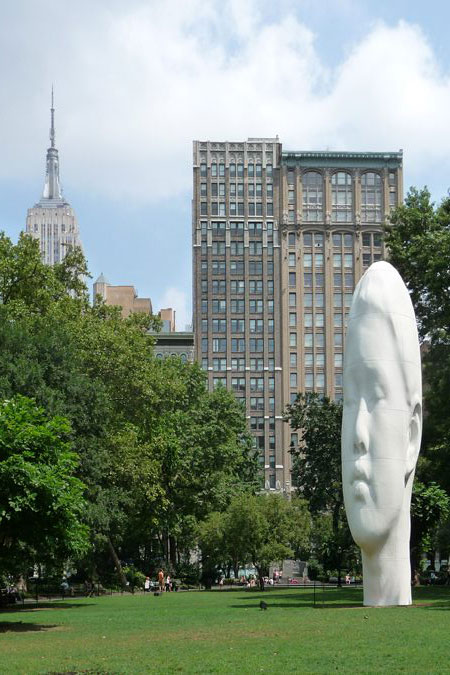
Echo, a belief-defying work by Spanish sculptor Jaume Plensa (JOW’-meh PLEHN’-sah) remains on view for only two more weeks, through September 11th. Like Plensa’s own Crown Fountain and Anish Kapoor’s Cloud Gate (aka The Bean), both in Chicago’s Millennium Park, Echo is both art and crowd-pleasing phenomenon. Sadly, unlike those works, Echo is not a permanent … Last Call for Jaume Plensa’s “Echo”
Midtown Undone
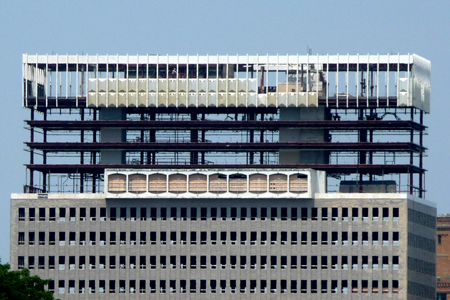
Photographed last week, Midtown Plaza’s piecemeal demolition brings the look of a ship breaking yard to the skyline of Rochester, New York. The image may be bracing to those who remember the project’s promise of urban renewal when it was completed in 1962, to the design of urban planner Victor Gruen. According to the Wikipedia … Midtown Undone
Windowflage, part 4
Linked Hybrid, a Beijing complex designed by Steven Holl, was completed last year. As with his Simmons Hall dormitory at MIT, Holl sets windows deeply into a uniform and pervasive grid, camouflaging them as dimples in an enveloping waffle texture that’s applied like shrink-wrap. He so accentuates the window grid that it takes on the geometric purity of abstract sculpture. Like many … Windowflage, part 4
Windowflage, part 3

“The Loneliest Job”, an unposed 1961 photo of JFK in the Oval Office by George Tames (The New York Times) shows how a window can express individual presence and uniqueness of outlook. At a traditional domestic scale, even an empty window invokes human presence as surely as a Van Gogh painting of an empty chair or pair of shoes. If … Windowflage, part 3
Windowflage, part 2

The architect Edward Durrell Stone built this Manhattan townhouse for himself at 13 East 64th Street in 1956. Stone’s American Embassy in New Delhi was under construction at the time of its design. He had given the embassy a similar screen to protect it from the sun, and here recycled the idea for privacy. Stone would go on using screens to … Windowflage, part 2
Windowflage, part 1
The Coney Island Elephantine Colossus is an object lesson in the need for windowflage, the camouflaging of windows in the service of a building’s overall sculptural effect. The work of Philadelphia architect William Free, it was built in 1883-85 as a hotel and later became a brothel. In 1896, it departed this world in true Coney Island style by burning down. … Windowflage, part 1
Architecture Meets Science Fiction at 41 Cooper Square

Thom Mayne’s new academic building for Cooper Union, 41 Cooper Square, is the Pritzker Prize winning architect’s first building in New York. Sensual, jarring and willfully strange, it’s unlike anything else in the city. New Yorkers won’t find a meaningful introduction to Mayne or his building anywhere in the popular press. Fifteen years ago, a … Architecture Meets Science Fiction at 41 Cooper Square
The Farnsworth House, part 3 / the progeny

When it was completed in 1951, the Farnsworth House was a window into the future. Still inspiring new interpretations, it has the open-endedness of great art. The economy with which the Farnsworth House elicits its richness of response is one proof of “less is more.” With minimalism and technology the tines of its tuning fork, the house’s reverberations are as … The Farnsworth House, part 3 / the progeny
The Farnsworth House, part 2 / from the hearth to the field
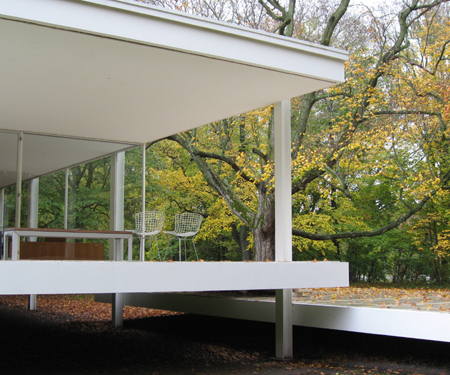
Mies van der Rohe prepared renderings of two early versions of the Farnsworth House, one on the ground and the other raised above it. The choice to elevate its floor five feet responded to potential flooding of the nearby Fox River, but also exalted the house, made it appear to float, and gave it … The Farnsworth House, part 2 / from the hearth to the field
The Farnsworth House, part 1 / whose less is more?

Mies van der Rohe’s Farnsworth House design was publicly presented in a 1947 Museum of Modern Art retrospective of his work curated by Philip Johnson. Mies had first conceived of a glass house in 1945. Johnson later said, “I pointed out to him that it was impossible because you had to have rooms, and that meant … The Farnsworth House, part 1 / whose less is more?
An Hour of Skyscrapers
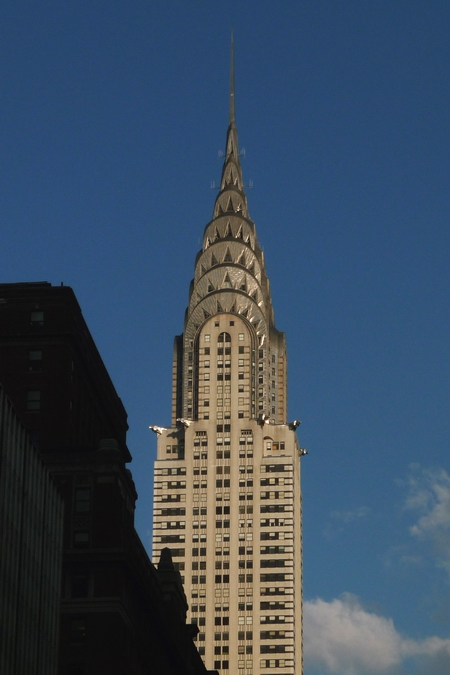
In his 1932 essay, The Frozen Fountain, Claude Bragdon wrote, “A building, however lofty, must end somehow, and the designer’s ability is here put to the severest test, and will be measured by the success with which this termination is affected – by the beauty with which his building dies on the white counterpane of … An Hour of Skyscrapers
Smarticulation

Smarticulation is facade articulation intended to make a building look purposeful and important. It is primarily found in large buildings with glass curtainwalls and achieved by crisply projecting or recessing an area of the facade by two or three feet. This shallow modeling has no impact on the use of the building, so it can be applied as an afterthought to … Smarticulation
How to Meet the Sky

Philip Johnson said that outdoor sculpture “lights up the sky”. He was talking about the way solid and void energize each other in an interplay of figure and ground, a principle that certainly applies to tall buildings. Flatiron Building postcard view Much of the Flatiron Building’s appeal to artists and photographers, for example, lies in its siting on an acute intersection where views allow … How to Meet the Sky
Influential "Life" Cartoon Turns 100
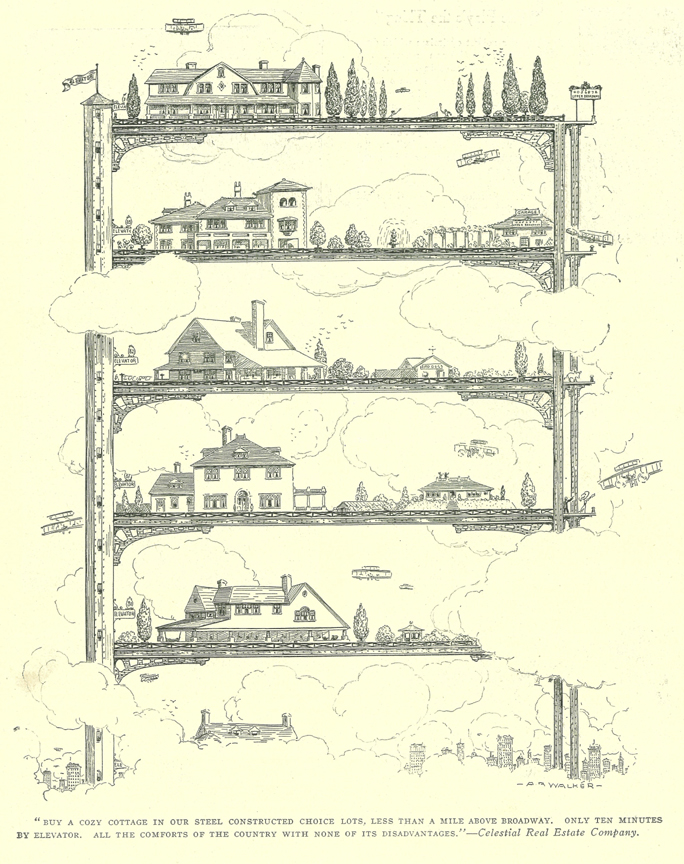
This year is the centenary of a cartoon that has had a remarkable influence on architecture. Published in Life magazine’s “Real Estate Number” of March, 1909, the full-page cartoon by A.B. Walker shows conventional houses stacked on an open skyscraper frame. Its caption reads, “‘Buy a cozy cottage in our steel constructed choice lots, less than a mile above Broadway. … Influential "Life" Cartoon Turns 100
Plug-in Architecture Loses an Icon

With Kisho Kurokawa’s Nakagin Capsule Tower (photo: Scarletgreen/Flickr) headed for demolition, the world will lose not just one of the few executed works of Japanese Metabolism, as noted earlier this month by Nicolai Ouroussoff in the New York Times, but a rare built example of plug-in architecture. The Capsule Tower might at first appear no more than a quaint, dated vision of … Plug-in Architecture Loses an Icon