
News
Saving Chelsea Market

David Burns of STUDIOS Architecture presented his firm’s vision of an expanded Chelsea Market, above, to a meeting of Community Board 4 last night, attended by residents wearing “Save Chelsea Market” buttons. He promptly heard one viewer’s verdict of “ugly building” endorsed by a peal of applause. The view above looks northeast from the West Side Highway. The design tries … Saving Chelsea Market
Where is Michael Bolla’s Lawsuit?

The doors of developer and real estate broker Michael Bolla’s 1835 rowhouse at 436 West 20th Street remain plastered with building notices over a year after a Daily News puff piece proclaimed it “one of the most perfectly restored homes in Manhattan.” On February 10, the Department of Buildings’ website indicated that the project was issued … Where is Michael Bolla’s Lawsuit?
The Seamy Side of 436 West 20th Street

436 West 20th Street has recently added a prominent steel I-beam above its roof ridge and a large skylight on its north slope as shown in this photo taken on September 15th. A visit that day to the Landmarks Preservation Commission and the Department of Buildings found no evidence of applications or approvals for these additions to the … The Seamy Side of 436 West 20th Street
Chelsea Mansion: The Art of Fiction

In February, a Daily News article by Jason Sheftell described 436 West 20th Street as “one of the most perfectly restored homes in Manhattan.” Cracked and displaced bricks and window lintels are now features of its façade, following restoration by its owner, the real estate broker Michael Bolla. ArchiTakes first reported on the building in a March post, “436 West … Chelsea Mansion: The Art of Fiction
436 West 20th Street Rises Above the Law

White stains of efflorescence mark new brickwork at 436 West 20th Street. The gable end of the 1835 rowhouse has been raised several feet and given a gambrel profile. The original peaked roofline is clearly legible in darker-looking brick, about four feet down from the new roofline. “You have to pay attention to history,” the building’s new owner and co-developer, Michael Bolla … 436 West 20th Street Rises Above the Law
Mapping New York's Shoreline, 1609-2009

Henry Wellge’s “Greatest New York”, published by The New York Times Company in 1911 and featured in a new exhibition at the New York Public Library, places the city within a liquid embrace. Its foreground features the Jersey City waterfront. New Jersey commuters transferred from Central Railroad of New Jersey trains onto ferries bound for Lower Manhattan, tracing a … Mapping New York's Shoreline, 1609-2009
Robert A.M. Stern, part 2

Stern’s presumptuousness may owe something to the huge attention and acclaim that attended upon 15 Central Park West, the luxury condo he designed for the Zeckendorf Brothers. Based on classic prewar apartment buildings by Rosario Candela, the project is probably the biggest real estate phenomenon New York has ever seen. Quarterly New York real estate reports had to be adjusted to factor … Robert A.M. Stern, part 2
Robert A.M. Stern, part 1
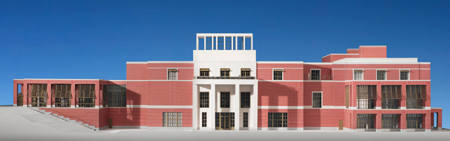
A rendering shows the main entrance of Robert A.M. Stern’s George W. Bush Presidential Center. “I’m not considered avant-garde because I’m not avant-garde,” Stern says, “but there is a parallel world out there – of excellence.” Earlier this month Robert A.M. Stern presented his preliminary design of the the Bush Library. Stern has just the right attributes to be … Robert A.M. Stern, part 1
Influential "Life" Cartoon Turns 100
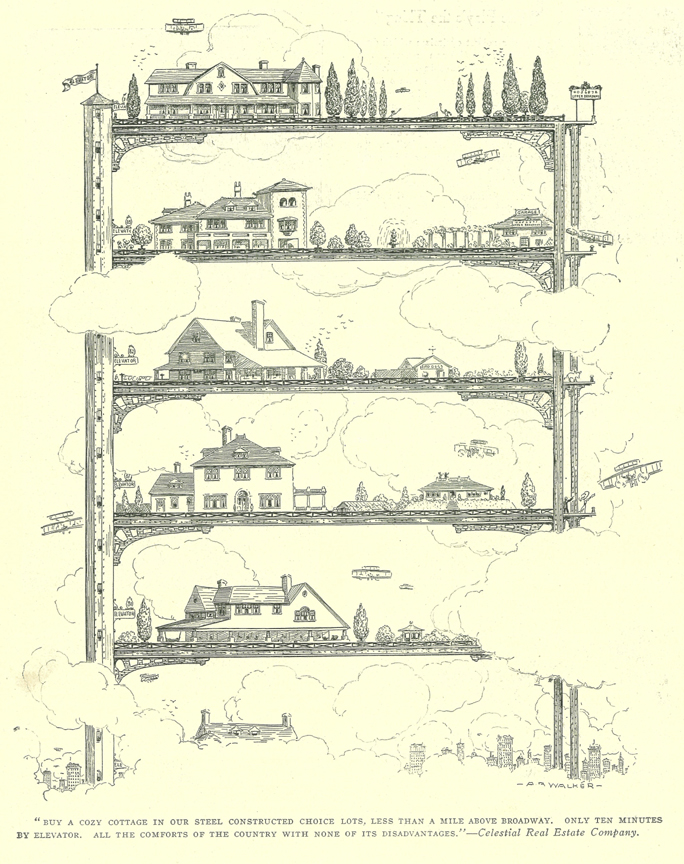
This year is the centenary of a cartoon that has had a remarkable influence on architecture. Published in Life magazine’s “Real Estate Number” of March, 1909, the full-page cartoon by A.B. Walker shows conventional houses stacked on an open skyscraper frame. Its caption reads, “‘Buy a cozy cottage in our steel constructed choice lots, less than a mile above Broadway. … Influential "Life" Cartoon Turns 100
Plug-in Architecture Loses an Icon

With Kisho Kurokawa’s Nakagin Capsule Tower (photo: Scarletgreen/Flickr) headed for demolition, the world will lose not just one of the few executed works of Japanese Metabolism, as noted earlier this month by Nicolai Ouroussoff in the New York Times, but a rare built example of plug-in architecture. The Capsule Tower might at first appear no more than a quaint, dated vision of … Plug-in Architecture Loses an Icon
Nouvel's Tower Verre Not the Only Vision in the Hearing Room

Jean Nouvel presented his design for the new MoMA tower in a public hearing at the City Planning Commission yesterday. Calling it “zee meezing peez of zee pizzle”, Nouvel made a case for the spike of his “Tower Verre” as a natural fit within the sawtooth rhythm of Manhattan’s skyline. Describing its lack of bulk and the way it leans back from the street and attenuates into … Nouvel's Tower Verre Not the Only Vision in the Hearing Room
Stanford White’s Bronx Pantheon To Lose Pride of Place

Ground has been broken on a new Bronx Community College building by Robert A.M. Stern that will leave Stanford White’s Gould Memorial Library off-center on its historic quadrangle.
CUNY Demolishes Historic Queens Building

The City University of New York has demolished a 1914 garage on its LaGuardia Community College campus that was part of the historic Loose-Wiles Sunshine Biscuit plant in Long Island City. The building had been protected by its formal status as “eligible” for listing on the State and National Registers of Historic Places until the New York State … CUNY Demolishes Historic Queens Building